DeepSeek V4 review is one of those topics where the headline sounds simple and the real story is not. DeepSeek released preview versions of V4 on April 24, 2026, and the internet immediately turned a model card into a sports event.
So here is the clean version. DeepSeek V4 is not a magic button that makes every closed model irrelevant tomorrow morning. It is also not just another pretty good open model. The interesting part is the combination: open-weight availability, a 1 million-token context window, a Pro model for hard work, a Flash model for fast work, and a design aimed at long agent workflows.
For more context on the 2026 model race, read our GPT-5.5 overview, GPT-5.5 vs Claude Opus 4.7 comparison, and Gemini 3 Pro review.
Overall Verdict: 8.3/10 for Builders, 7.4/10 for Casual Chat
The Short Version
DeepSeek V4 is best understood as a serious open-weights model family built for long-context work and agents. It comes in two main versions: DeepSeek-V4-Pro, a 1.6T-parameter Mixture-of-Experts model with 49B activated parameters, and DeepSeek-V4-Flash, a 284B-parameter model with 13B activated parameters. Both support a 1 million-token context window.
That number is the obvious flex, but efficiency is the real story. Long context is only useful if the model can operate inside it without melting your budget, patience, or GPU stack. My score: 8.3/10 for developers, researchers, and AI builders. For normal chatbot use, it is closer to 7.4/10.
What's New: Two Models, One Giant Context Window
Pro vs Flash
DeepSeek V4 has a clean split. Pro is the big brain version. Flash is the faster, lighter version. Most people do not need the heaviest model for every prompt. For quick summaries, Flash makes sense. For repo inspection, log analysis, and multi-step planning, Pro is the one you test.
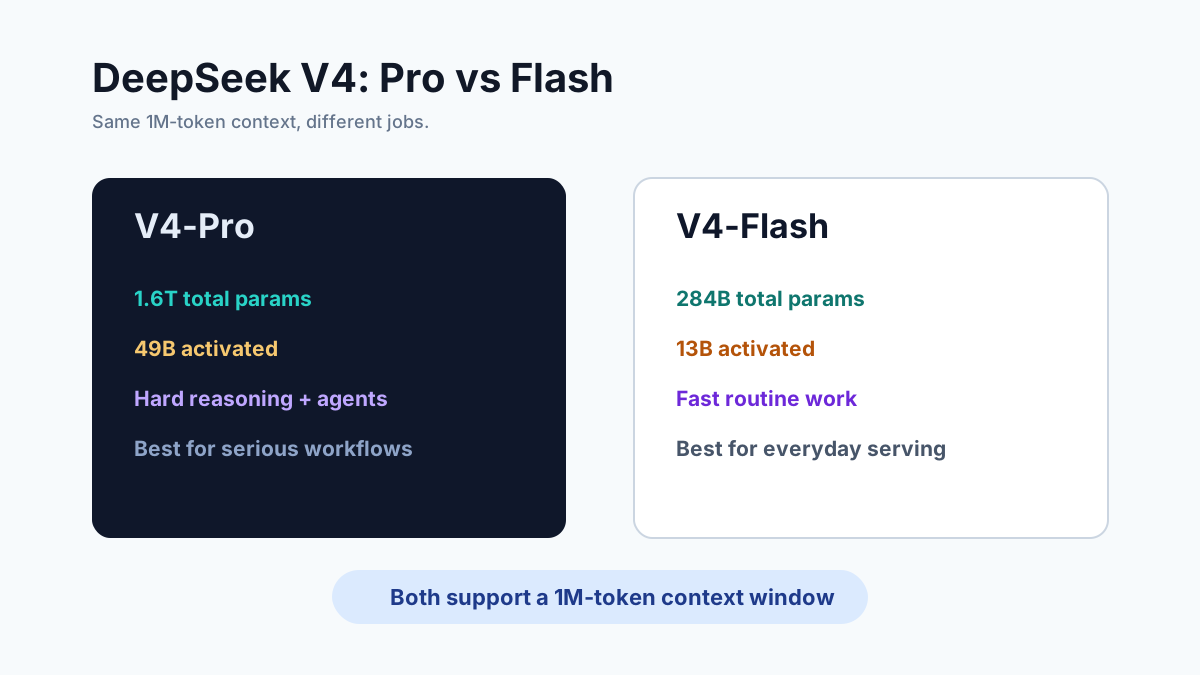
The Pro model gets the attention because 1.6T total parameters looks enormous on a spec sheet. But because it is MoE, only part of the model activates per token. Flash may be the more practical product: if it stays close enough to Pro for routine agent tasks, it becomes the everyday workhorse. Pro is the flagship phone. Flash is the one most people should probably buy.
The Million-Token Question
A 1 million-token context window sounds like giving the model a warehouse-sized desk. You can throw in a technical report, half a codebase, meeting notes, customer feedback, and the weird CSV someone exported at 2 a.m. But context length is not memory, judgment, or truth. A model can fit a lot of text and still miss the paragraph that matters.
DeepSeek's real claim is not only that V4 can hold more context, but that its hybrid attention design makes that context cheaper to use. The model card says V4-Pro needs far less single-token inference compute and KV cache memory than V3.2 at the 1M-token setting. That matters because agents call tools, read outputs, correct mistakes, and keep moving.
Performance: Strong, Especially for Agent Work
Coding and Tool Use
DeepSeek V4 is clearly aimed at workflows where the model does not just answer, but works: coding, terminal tasks, browsing, structured tool calls, long research loops, and multi-step planning.
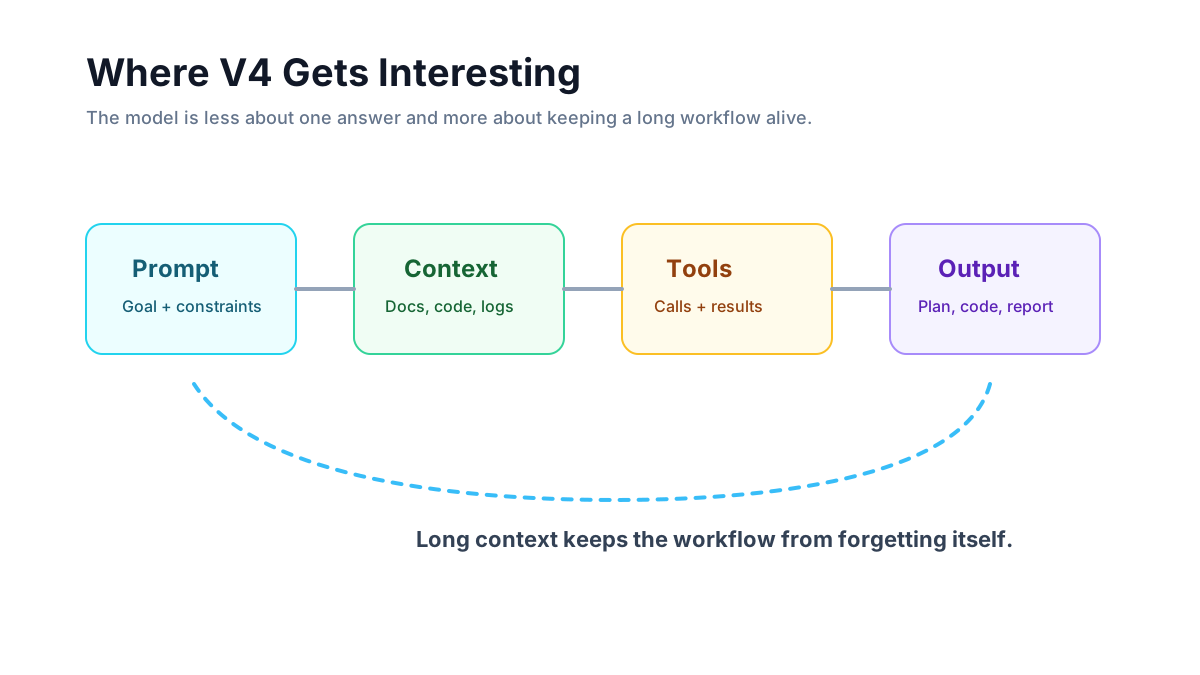
The official material emphasizes agentic capabilities, reasoning effort modes, and a tool-call format designed to reduce parsing errors. That sounds boring until you have watched an AI agent break because it escaped one quote wrong inside a JSON string. Then it sounds beautiful.
In early benchmark claims, V4-Pro-Max looks competitive with closed frontier models on several coding and agent tasks. That does not mean it wins everything. It means the gap is small enough that developers will actually test it.
Reasoning and Knowledge
For reasoning and knowledge, the verdict is more measured. V4 looks strong, but not universally ahead. DeepSeek's own comparisons put it in the conversation with top models from OpenAI, Google, and Anthropic, but those are still vendor numbers. Independent evaluations matter, and benchmarks are not the product.
In practice, I would expect DeepSeek V4 to shine in long technical analysis, codebase exploration, document comparison, and agent experiments. I would be more cautious with high-stakes legal, medical, financial, or geopolitical output unless you have a strong verification workflow.
The Catch: Open Does Not Mean Easy
Running It Is Still Serious Work
Open weights are great. MIT licensing is developer-friendly. But do not confuse available with easy. A 1.6T MoE model is not something you casually run on a laptop while Chrome has 47 tabs open. Even Flash is a serious model.
For most users, the practical path will be hosted inference, third-party providers, or optimized community builds. That is fine, but it means the V4 experience may vary depending on quantization, exposed context limit, and reasoning-mode support.
The Politics Are Part of the Review
DeepSeek V4 also lands in a complicated moment. AP reported that the rollout is tied to China-U.S. AI competition, Huawei chip compatibility, and ongoing claims from U.S. labs about model distillation. Those allegations are separate from whether V4 is useful, but they affect trust. Ask three questions: Is the model technically strong? Is the license useful? Is deployment trustworthy for your use case?
Who Should Use DeepSeek V4?
Best Fit
DeepSeek V4 is a strong fit for developers, AI researchers, startups building agents, teams working with long documents, and anyone who wants an open-weight alternative to closed frontier models. If your workflow involves code, tools, logs, retrieval, or long project context, this is worth testing. It is also interesting for companies that want more control over deployment.
Who Should Wait
If you mainly use AI for quick daily tasks, you do not need to rearrange your life around V4. ChatGPT, Claude, Gemini, and other assistants may still offer smoother consumer experiences, better multimodal polish, and simpler access. V4 is primarily presented as a language model family, so compare carefully if your main need is image, video, or polished multimodal creation.
DeepSeek V4 Is Pressure, Not a Knockout
DeepSeek V4 is one of the most important AI releases of 2026 so far because it pushes the open model world closer to serious long-context and agentic work. The spec sheet is loud: 1M context, Pro and Flash models, open weights, big benchmark claims. But the quieter story is better: DeepSeek is trying to make long-running AI workflows cheaper and more practical.
The neutral take is this: V4 is not automatically better than GPT, Claude, or Gemini. It is not an instant replacement for every closed model. But it is good enough, open enough, and ambitious enough that it changes the comparison.
Sources: DeepSeek-V4 Pro model card, Hugging Face DeepSeek-V4 technical overview, and AP News DeepSeek V4 report.
Written by
Iris Chen
Model Research Writer
Iris covers frontier models, open-weight releases, benchmarks, and the practical tradeoffs behind AI infrastructure decisions.
AI model watch
Track AI model launches with context, not recycled hype.
Read more Syntax Dispatch coverage on AI models, open-weight releases, practical tooling shifts, and real workflow changes.
Browse AI coverageFAQ
Is DeepSeek V4 open source?
DeepSeek V4 is available as an open-weight model family under an MIT license on Hugging Face, which makes it more developer-friendly than closed API-only models. Deployment still requires serious infrastructure for larger variants.
What is DeepSeek V4 best for?
DeepSeek V4 is best suited for long-context work, coding, agentic workflows, document analysis, tool use, and teams that want more control over model deployment.
Should casual users switch to DeepSeek V4?
Not automatically. Casual users may still prefer ChatGPT, Claude, Gemini, or other polished assistants for everyday chat, multimodal features, and simple access.